


Outlook
Bangladesh’s High-Stakes 2026 Election: BNP’s Return, Jamaat’s Resurgence, and the Unsettled Opposition Equation
Thu Feb 12 2026 || Author : Shantanu Mukharji
Abstract
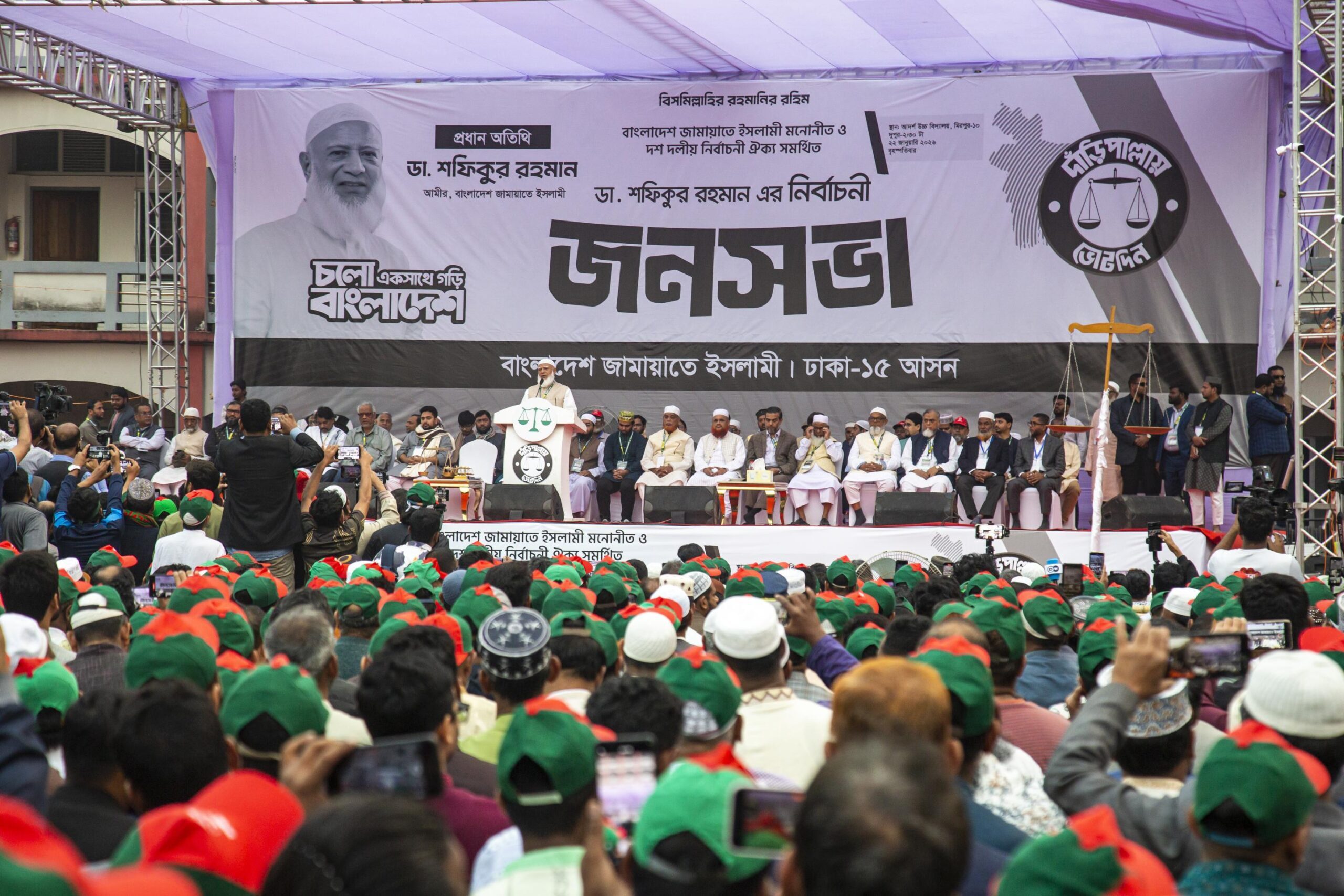
Bangladesh’s 2026 parliamentary election marks one of the most consequential political moments since 1971, unfolding in the aftermath of Sheikh Hasina’s exit from power. This article examines the reassertion of the Bangladesh Nationalist Party under Tarique Rahman, the resurgence of Jamaat-i-Islami in search of political redemption, and the intense contestation surrounding the Election Commission. It analyses Jamaat’s urban momentum and rural limitations, the volatile narrative politics shaping the campaign, and the uneasy, transactional BNP–Jamaat dynamic in a post-Hasina vacuum. Together, these factors reveal an unsettled opposition equation and a deeply uncertain democratic transition.
The Post-Hasina Political Vacuum and BNP’s Return to Centre Stage
Bangladesh stands at a critical, arguably the most consequential, juncture in its political history since 1971 as it approaches its 13th Jatiya Sangsad (parliamentary) elections, scheduled for 12 February 2026.
The country’s electoral temperature has been steadily rising, marked by sharp exchanges, procedural disputes, and competitive mobilisation across the political spectrum. Yet, unlike previous elections dominated by a singular contest between the ruling Awami League (AL) and an embattled opposition, the current moment is defined by a deeper recalibration of power following the fall of Sheikh Hasina’s government in 2024, not without intervention by external forces.
At the centre of this recalibration is the Bangladesh Nationalist Party (BNP), which has moved swiftly to reclaim political centrality after years of alleged repression, marginalisation, and organisational stagnation. The return of its acting chairman, Tarique Rahman, on 25 December last year has injected fresh momentum into the party, widely seen as being shrouded in tacit Western support. Since then, Tarique has engaged extensively with party cadres, civil society actors, diplomats, and the media, signalling both a revival of leadership visibility and an assertion of political intent, almost hinting that he has arrived.
Beyond symbolic presence, Tarique has sought to reposition the BNP as the principal custodian of Bangladesh’s democratic transition. This effort has been most evident in his attempt to reclaim the political narrative surrounding the July 2024 uprising. Speaking on 18 January at the Krishibid Institution Bangladesh (KIB) in Dhaka, while interacting with families of those killed and injured during the unrest, Tarique framed the July uprising as a genuine mass movement rather than a party-driven agitation. He argued that the movement belonged to people who had been systematically deprived of their rights, echoing a long-standing opposition claim against the Awami League.
In a deliberate historical juxtaposition, Tarique described 1971 as the struggle for independence and the 2024 uprising as the struggle to protect that independence and sovereignty. “The independence achieved in 1971 was safeguarded through the 2024 movement,” he said, adding that the July protesters should be formally recognised as freedom fighters. This rhetorical move was not merely commemorative – it sought to embed the BNP within the moral architecture of Bangladesh’s national history.
Tarique went further, promising that a BNP-led government would establish a dedicated department under the Ministry of Liberation War Affairs to support the families of those killed and injured during the uprising. He claimed that more than 1,400 people were killed and nearly 30,000 injured, with many suffering permanent disabilities, and described the episode as a “genocide.” Emphasizing the stakes of the upcoming election, he called it “extremely, extremely important” for restoring “a safe and democratic Bangladesh.”
With Sheikh Hasina no longer dominating the political landscape, the opposition space has shifted from one of resistance to one of competition. This shift has forced older alliances to be reassessed and new equations to be explored, setting the stage for a more complex and uncertain electoral contest.
The Election Commission as Arena: Power, Parity, and Positioning
As the political field reconfigures, the Election Commission (EC) has emerged as the principal arena of confrontation. Both the BNP and Jamaat-i-Islami (JI) have directed sustained criticism at the commission, accusing it of partiality, procedural manipulation, and administrative collusion.
On 18 January, a BNP delegation met the EC to register a series of formal complaints. Later the same evening, a Jamaat delegation led by party Ameer Dr Shafiqur Rahman met Chief Adviser Professor Muhammad Yunus, seeking assurances of neutrality and a level playing field. The timing and symmetry of these engagements underscored the intensity of the contest over institutional legitimacy.
BNP Secretary General Mirza Fakhrul Islam Alamgir accused the EC of “questionable conduct” across several fronts, alleging bias in favour of “a certain party,” widely interpreted as Jamaat. He claimed that political actors were violating the electoral code of conduct by launching campaigns ahead of the formal notification and that returning officers, assistant returning officers, police superintendents, and other officials in many constituencies were acting to benefit only one party.
The BNP further alleged that Jamaat activists were violating electoral norms by collecting copies of National Identity Cards, mobile numbers, and bKash (Bangladesh’s mobile money platform) details door to door, actions it described as criminal breaches of personal privacy. The party demanded urgent EC intervention and reiterated its long-standing demand for free and fair elections under strict enforcement of the code of conduct.
Procedural disputes extended to the handling of postal ballots for expatriate voters. The BNP described the process as “problematic,” arguing that ballots were being printed and dispatched without adequate safeguards. It demanded that postal ballots within the country be distributed only after electoral symbols were allocated and arranged identically to those used on polling day.
Additional concerns were raised about large-scale voter transfers into Dhaka constituencies, allegedly undertaken unethically to create electoral advantage. The BNP demanded full transparency regarding the number of transferred voters, their origins, destinations, and justifications.
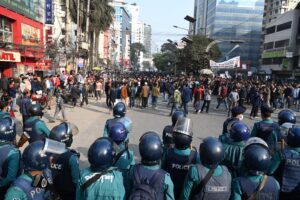
These institutional battles spilled onto the streets when the BNP’s student wing, Jatiyatabadi Chhatra Dal (JCD), staged a sit-in protest outside the EC building. Protesters alleged manipulation of expatriate ballots and objected to a gazette notification scheduling student union elections at Shahjalal University of Science and Technology ahead of the general polls, allegedly under pressure from a student body linked to a particular party.
Beneath these procedural disputes lies a deeper struggle over who will shape the post-Hasina political order and who will benefit most from it.
Jamaat’s Counter-Offensive and the Search for Political Redemption
JI has responded to BNP accusations with a counter-offensive of its own, positioning itself as a victim of institutional bias rather than a beneficiary of it. Speaking at a journalists’ briefing on 18 January after meeting Chief Adviser Yunus, Jamaat Nayeb-e-Amir Syed Abdullah Mohammad Taher alleged widespread irregularities in the electoral process.
Taher claimed that deputy commissioners and superintendents of police were acting in a biased manner and pointed to inconsistencies in the scrutiny of nomination papers. According to him, similar cases involving loan defaults and dual citizenship were being treated differently by the EC. He further alleged that representatives of rival political parties had approached the EC to influence decisions so that nominations liable to rejection were allowed to stand.
While stating that Jamaat had no objection to enhanced security for any political leader, Taher demanded parity in security arrangements and protocol for the party’s Ameer. The emphasis on institutional fairness and procedural equality reflected Jamaat’s broader attempt to present itself as a rule-bound political actor.
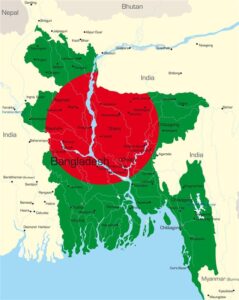
These exchanges occur as Jamaat seeks to reestablish itself at the centre of Bangladesh’s political mainstream following its legal reinstatement after 2024. The party’s trajectory from an Islamist organisation to a coalition partner with cabinet representation, then to a banned entity and the execution of many of its key leaders, and now to a legally operating political force mirrors the broader shifts in Bangladesh’s political landscape. This reversal, however, would not have been possible without the complete political exit of Sheikh Hasina, reflected in her forced removal from power and the subsequent ban on her party. Taken together, these developments suggest a convergence of anti-Mujib, anti-Hasina and anti-Awami League forces, both internal and external, coming together to reshape Bangladesh’s political order.
Available indicators suggest that Jamaat’s contemporary strength is concentrated in urban areas and among educated voters. In cities such as Dhaka and Chittagong, the party has built dense organisational networks. Its student wing, Islami Chhatra Shibir, recorded notable victories in campus elections in 2025, underlining its appeal among younger, educated constituencies.
This urban support has been cultivated over time through sustained social outreach. Jamaat operates extensive networks of madrasas, schools, charities, and health facilities, alongside interests in medical, educational, and financial institutions. These structures allow the party to mobilise quickly during crises, generating visibility and loyalty.
Taken together, these moves point to a deliberate effort by Jamaat to reposition itself as a legitimate stakeholder in democratic politics, an effort increasingly framed by the party and its supporters as a search for political redemption after decades of marginalisation and the historical stigma arising from its brutally murderous role in the suppression of the 1971 Liberation War, marked by large-scale killings and sexual violence—arguably the most horrific genocide in the annals of East Bengal, East Pakistan, and Bangladesh’s history.
Urban Momentum, Rural Limits, and the Arithmetic of Dependence
Despite its urban gains, Jamaat’s national ambitions remain constrained by structural realities. In rural Bangladesh, where the majority of parliamentary seats are located, politics continues to revolve around local leaders aligned with the Awami League or the BNP, who promise tangible benefits such as roads, credit, and employment.
Jamaat’s ideological emphasis on Islamic governance and social justice resonates less with the immediate economic concerns of farmers and daily wage labourers. The party’s historical opposition to the 1971 Liberation War and the legacy of war crimes trials continue to shape negative perceptions, particularly outside urban centres. Support among minority communities, including Hindus and ethnic groups, is even lower, driven by fears regarding religious priorities.
During crises such as floods, rural populations typically rely on government relief or the networks of larger parties rather than Jamaat’s organisational structures. This pronounced urban–rural divide defines Jamaat’s electoral ceiling.
Surveys conducted in late 2025 nevertheless indicate a discernible rise in Jamaat’s popularity, placing it at approximately 26 per cent support, with the BNP at around 30 per cent and the Awami League significantly lower. This represents a dramatic increase from earlier electoral cycles, when Jamaat’s support hovered around 4 to 5 per cent during its period of proscription.
Yet historical trends suggest that securing a national majority remains extremely difficult. Jamaat has never independently crossed the 10 per cent vote share threshold. Even under favourable conditions, projections indicate that it may secure 20 to 30 parliamentary seats as part of an alliance, reinforcing its dependence on larger partners.
The murder of young activist Hadi in late 2025 added a volatile narrative dimension. Rumours alleging foreign involvement, particularly by India, spread rapidly, with Hadi portrayed by some as a martyr for Islamic values. Jamaat was accused of amplifying these narratives through public speeches and selective circulation of protest videos, deepening social polarisation and complicating investigations.
The BNP–Jamaat Tryst: Necessity, Mistrust, and an Unsettled Future
Notably, bloody skirmishes between Jamaat and BNP workers, reported at the time of writing, lay bare the brutal struggle for supremacy between the two political entities. Having earlier acted in concert to push Sheikh Hasina out of power, they are now engaged in open confrontation to capture the political vacuum created by the July 2024 “uprising,” widely seen as orchestrated rather than spontaneous.
In the absence of Sheikh Hasina and a dominant Awami League, the BNP and Jamaat now find themselves locked in a relationship neither fully trusts nor can easily abandon. Their engagement is less an alliance of conviction than a tryst of necessity, driven by electoral arithmetic, mobilisation capacity, the absence of viable alternatives, and simply the quest for power. Jamaat is conscious of the necessity of ascending to power to actualize its long-cherished politico-religious ideology.
Despite a long history of cooperation, present relationship between the BNP and Jamaat is visibly strained and likely to become increasingly bloodier. Disputes over ideological positioning and voter perception have intensified. Jamaat’s push for greater urban representation clashes with the BNP’s concern about alienating moderate voters wary of religious politics.
The anticipated return of Tarique Rahman to power may further sharpen these tensions. From abroad, he has signalled a more centre-right, less religion-centric vision for the BNP, emphasizing unity beyond religious identity. His physical return could empower factions within the BNP seeking to project a modern, inclusive image, directly clashing with Jamaat’s ideological priorities.
Bangladesh’s foreign policy, particularly relations with India, adds another layer of complexity. Jamaat’s leadership has articulated a stance of “friendship with all, enmity with none,” including India, based on equality and sovereignty. The BNP’s past record, however, raises questions about continuity and change. For New Delhi, the evolving BNP–Jamaat equation represents both a risk and an opportunity, demanding proactive diplomacy and robust counter-intelligence.
Conclusion: A Tryst Born of Vacuum, Not Vision
Bangladesh’s approach to the 2026 elections is being shaped less by ideological clarity than by structural compulsion. Jamaat’s resurgence represents an attempt at political redemption, grounded in urban mobilisation and institutional participation but constrained by history and geography. The BNP, while remaining the principal opposition force, confronts its own limitations in mobilisation and legitimacy, as well as external forces seeking Jamaat’s ascent on Bangladesh’s political turf.
The resulting BNP–Jamaat tryst is transactional, uneasy, and conditional, to keep Hasina out of power. It is sustained not by shared ideology but by mutual dependence, and tested continuously by questions of power-sharing, public perception, and foreign policy.
Whether this relationship matures into a durable governing partnership or collapses under the weight of its contradictions is likely to be reflected in the impending electoral outcomes by the morning of 13 February, in subsequent post-poll negotiations if no political party bloc secures a clear majority, and in the Yunus–General Waker factor, widely understood to be scripted by Western forces. For now, it remains real, consequential, and unresolved, mirroring the broader uncertainty of what is perhaps Bangladesh’s most consequential political transition.
(Writer, is a retired IPS officer, Adviser NatStrat, and a former National Security Advisor in Mauritius.)
157 thoughts on “Bangladesh’s High-Stakes 2026 Election: BNP’s Return, Jamaat’s Resurgence, and the Unsettled Opposition Equation”
Leave a Comment
Social Media Updates
 Facebook
 Instagram
 YouTube





https://shorturl.fm/twDf4
Pingback: bacterial sinusitis
The app performance is seriously impressive and I never experienced any lag during my favorite games. Customer service is available around the clock and they always solve my issues with a smile. I recently tried the new slots section and it was a blast from start to finish. Make sure to check out inwabetapp for an unmatched mobile gaming journey.
Finding a legitimate platform that actually lets you withdraw your winnings without unnecessary delays is rare these days. This one checks every box with fast processing and a secure environment. I played a few rounds after work and walked away with a great bonus boost. You should definitely visit pk777earningapp to experience the difference.
The sportsbook section here is absolutely world class with incredibly competitive odds and a seamless betting flow. I love how easy it is to place live wagers while watching the match and the cash out feature works flawlessly every time. If you want a reliable place to bet on your favorite teams then look no further than satsportlogin.
https://shorturl.fm/T5GOW
Finally found a platform that actually pays out fast. The interface is super smooth and the games are addictive. Highly recommend jilibet888app for anyone looking for a legit experience.