



Outlook
Abstract
The recent collapse of the Sheikh Hasina government in Dhaka in August 2024 was in the interests of external forces that had sustained internal efforts to dismantle the Awami League Party rule. In ways the Sheikh Hasina Government had kept its closeness to Delhi yet created a goodwill in Beijing also. The emerging political chaos in Bangladesh and its descent in to Islamic fundamentalism does not seem to be in the interest of the two major regional powers, China and India. This brief study into the Bangladesh crisis is to bring out different external and internal factors that have led to the present impasse which though difficult for India may not be in the interest of China either. And hence it should not be seen as a zero-sum game between China and India over Bangladesh since bringing about political stability in Bangladesh would benefit both countries along with the regional situation.
Changing contours in Bangladesh post-Hasina
Bangladesh is a country that is strategically situated along the eastern seaboard of India at the head of the Bay of Bengal and spreading down halfway along the eastern coastline of Bay of Bengal having the most important deep sea port of Chittagong. The eastern states of India are spread across like a fan on the northern boundary of Bangladesh. Bangladesh’s political history since its break up from West Pakistan in 1971 with the help of Indian Military intervention and becoming an independent state is marred by numerous political crises, military coups and dictatorships and political assassinations. But the past three decades since 1991 there has been political and economic stability in Bangladesh.
Presently Bangladesh has entered a period of political turmoil and constitutional crisis when the incumbent prime minister Sheikh Hasina Wazed, duly elected though in a General Elections in January 2024 that were marred by non-participation of the entire political opposition parties, had to finally flee the country to India on August 5, 2024 after sustained student protests across Bangladesh on job quotas in government sector. The interim prime minister sworn in to fill the power vacuum was Mohammad Yunus, a hitherto social activist known for his NGO, who had built his reputation on micro finance schemes and enterprise spread across poverty stricken Bangladeshi lower classes. But Mohammed Yunus was simply a figurehead put in as a stop gap measure with support of the foreign economic backers of Bangladesh and countries such as the United States that were vocally contesting the validity of Sheikh Hasina’s re-election.
Sheikh Hasina as the prime minister of Bangladesh has been known being pro-India and her party Awami League has historically been the protector of Bangladeshi minorities mainly Hindus. Further she was also known to be consonant with the Indian sensitivities regarding the role of other major powers into Bangladesh internal matters bordering India. Hence her exit from power has opened India’s sense of unease at the acts of the interim or new authorities in Bangladesh on matter where Indian interests are affected. And since India finds working with western powers in Bangladesh as to its strategic advantage, this fear pertains mainly to the role of China.
China and Bangladesh
China’s role in Bangladesh has mainly been economic, though various military governments in Bangladesh since 1975 have relied on the import of Chinese military assistance and equipment, since that was available on cheap and favourable credit terms. But since India was the giant neighbour bordering Bangladesh, with much greater military and economic power, the role of other major powers did not materially affect India’s security or interests. But as India’s relative economic role and power declines in Bangladesh vis-à-vis China, India’s strategic vulnerabilities were bound to rise in the Bangladesh sector. And that became more pronounced with the sudden ouster from power of the pro-India prime minister Sheikh Hasina by political forces that are openly Islamist and hostile to Indian interests. Even though China may not have much in common with these new political forces in Bangladesh, these political forces are bound to use the latent Sino-Indian tensions to their advantage against India.
It is an economic fact now that China is the second largest economy in the world, with the largest manufacturing sector in the global economy and the largest export surplus. Most nations depend on China for their economic imports and needs. Both India and Bangladesh have large trade, both in quantum and deficit, with China, and under these conditions China has emerged as Bangladesh’s, as well as India’s, single largest trading partner. Moreover, China has been Bangladesh’s largest trading partner for 15 consecutive years, with bilateral trade exceeding $23.9 billion in 2023. Bangladesh’s exports to China, on the other hand, have shown a promising trend, increasing steadily and significantly. They peaked at just $740 million in 2021, from $13 million in 2003.
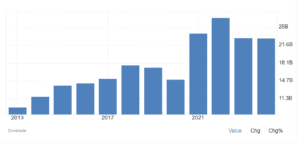
China’s export to Bangladesh. Source: Compiled from the United Nations Comtrade database on international trade, as accessed and visualised by Trading Economics. China’s exports to Bangladesh amounted to USD 22.88 billion in 2024. Trading Economics, China Exports to Bangladesh, last updated January 2026; data retrieved on 14 January 2026 from [source]
In statistical terms, as a critical economic aid provider, China has over the last decade released $4.45 billion for 35 different projects as part of the BRI in Bangladesh. These are mainly infrastructure projects in sectors such as transportation, energy, power, and communications within Bangladesh. China also provided financial and technical support for building the 5G telecom network in Bangladesh. Though some Western economic critiques of Chinese aid talk about the associated increase in the overall debt burden on the Bangladesh economy, yet it must be factored in that the Chinese have provided some key transport corridors and energy generation assets in Bangladesh.
Further, Chinese sources show that in 1995, China exported $652 million worth of goods to Bangladesh. And nearly thirty years later, in FY24, Bangladesh imported goods worth $16.63 billion from China, representing 26.4 per cent of the country’s total imports for that year. In the year 2006, China had replaced India as the largest trading partner for Bangladesh, showing its economic heft in India’s neighbourhood.
Chinese economic data show that in 2016, with Bangladesh’s formal entry into the BRI, China pledged $24 billion in loans and aid, marking Bangladesh’s most significant foreign investment commitment to date. Yet how much of that commitment has materialised in actual projects is yet to be seen. Still, this substantial capital inflow has been directed towards vital infrastructure projects such as power plants, bridges, highways, and industrial parks, providing for some vital economic needs of Bangladesh.
According to the World Integrated Trade Solution (2025) data, from 2002 to 2012, prior to the BRI, Bangladesh’s imports from China steadily increased from $922 million to $6.4 billion, reflecting a growing trade relationship. However, after the BRI’s inception in 2013, imports surged dramatically, reaching $20.2 billion by 2022. This sharp increase in trade volume underscores the BRI’s profound influence on deepening economic ties.
Since Bangladesh mainly exports garments to the Western and American economies, all its intermediate goods are imported from China for further processing and export to international markets. Further, Bangladesh, being granted “least developed country” status by China, has almost tariff-free access to the Chinese markets. Yet Bangladesh runs a trade deficit with China due to its imports of intermediate goods that need processing before re-export. China is also Bangladesh’s greatest economic aid and assistance provider, which it does in terms of development and infrastructure projects, widely outpacing India’s economic aid in the same sphere. It has to be understood that Bangladesh does not have any land border with China. Hence, China’s aid under the BRI does not have similar strategic significance as in the case of Pakistan and CPEC.
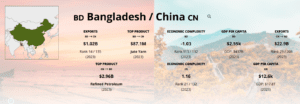
China-Bangladesh bilateral trade data. Source: Observatory of Economic Complexity (OEC), MIT Media Lab (Macro Connections). Trade data derived from UN Comtrade and harmonised, processed, and visualised by OEC. Trade between Bangladesh and China (2024). Retrieved 14 January 2026 from [source]
Vectors of Chinese foreign policy
It is further pertinent to cast light on China’s foreign policy priorities in the international system today to understand its role in Bangladesh. China’s foreign policy orientation primarily has four primary thrusts vectors according to its emerging threat perceptions. These four are starting with (1) North Asia (Korean Peninsula), (2) East Asia (Japan/USA), (3) Taiwan, and (4) South China Sea. Other than this China’s dominating foreign policy agenda is to keep economic growth and political stability along its border regions and in the larger Eurasian region again to allow China to focus on its own economic growth agenda. China sees western political interference in this region mainly to create political instability to deny China the upcoming economic advantage due to its superior economic strength. Finally, China strives to create land connectivities across the Eurasian Continent to bypass any maritime chokepoints where western states can have an advantage, hence the BRI initiative. The building of roads/highways/ railroads by China under BRI through till now impassable natural mountain barriers across inner Asia is a historical achievement for China.
Chinese South Asian Foreign Policy
South Asia emerges in the Chinese foreign policy focus as a geographical unit with India as being the primary centre of attention being the largest state actor and having the largest land border with China and further dominating the Indian Ocean Region (IOR) astride the maritime chokepoints. The other smaller South Asian states flanking India are seen by China in a descending order of importance as Pakistan, Bangladesh, Nepal, Sri Lanka and Bhutan. Afghanistan under Taliban is also receiving large Chinese economic aid and financial assistance in building infrastructure. Hence Bangladesh is an outlier in this geographical setting in getting Chinese economic assistance for reasons mentioned as above. China does not attempt as stated in its policy towards Bangladesh as of “non-interference in internal affairs” to foist any ideologies whether political or religious on other states leaving it to the internal forces to manage. Hence Chinese side would not dwell much on the Islamist orientation of new Bangladeshi interim state authorities under Mohammed Yunus or others.
Further to understand Chinese foreign policy actions towards South Asia region one has to factor in that they are more of a reaction to Indian foreign policy orientation and actions whether on its own or as part of a coalition of states particularly Western as in QUAD or Indo-Pacific that forces China to recalibrate its foreign policy posture towards the region from time to time. Hence one of the dominating objectives of Chinese foreign policy posture in South Asia is to keep a balance of power in this region that may not suit the interests of rising power of the Indian side in the immediate or long run to dominate its immediate neighbourhood. It has to be understood that despite the long land border between South Asia and China, there is minimal direct Chinese interaction due to the geographical constraints as put up by the Himalayas.
Moreover, most of the recent political upheavals or shifts across the South Asian or Indian ocean region have origination more out of both Indian and the South Asian region’s proximity to Middle East/ Arabian Peninsula region which has remained a centre of political instability, wars and rising Islamic Wahhabi fundamentalism such as in Syria and Yemen. The relative weakness or position of India both in military and economic terms despite its growing economy vis-à-vis other state actors in the region such as Saudi Arabia, Turkey and Iran has allowed India’s immediate periphery such as Maldives and Bangladesh to fall under Islamist sway with Pakistan already being an Islamist state now joined by Bangladesh. All these Islamist state entities seek economic aid from China to balance or curtail dependence on India’s economic ties.
Resurgence of Islamist forces in Bangladesh: regional power alignments and strategic implications for India
Bangladesh’s dalliance with Islamists with anti-India mindset is not a new phenomenon as it was the Islamists in East Pakistan whose atrocities had led to the East Pakistan civil war and the creation of Bangladesh in 1971. But the re-emergence of the Islamists in the Bengali garb is more recent phenomenon and owes much due to the impact of events in the middle east and economic ties with that region. The largest Bangladeshi immigration for employment as labour is by
far largest in the Gulf Cooperation Council (GCC) countries numbering as much as 8 million with Saudi Arabia and UAE being the largest employers. Almost 1 million Bangladeshi labour has been allowed into Saudi Arabia since the coming of the Islamist interim state authorities in Dhaka in year 2025 itself. Remittances from Saudi Arabia to Bangladesh alone amount to more than 5 billion USD. This has much bearing on the Islamist mindset in Bangladesh which has been historically anti-India and to atrocities against Hindus and minorities and as such has nothing to do with Chinese involvement in Bangladesh.
The animosity shown by western states towards the Hasina government in Dhaka despite its secular outlook is another factor that needs to be understood. Bangladesh under Hasina had close historical ties to Russia which led to the building of the Noorpur Nuclear Power Plant with Russian technical and financial aid amounting to almost 13 billion USD. The under construction Noorpur 2200 MW nuclear power plant had the potential to turn Bangladesh into energy self-sufficiency while aiding economic expansion at a time of declining natural gas deposits. But the American side was particularly against this nuclear project being built with Russian assistance and even more so after financial sanctions imposed on Russia in the aftermath of the war in Ukraine post February 2022. Further on, Hasina did not allow the western states to use the Rohingya issue to arm Muslim entities in Burmese Rakhine state or to influence the Myanmar civil war with arms supplies to rebels against the Myanmar Government. India too has been supporting the Myanmar military in this civil war. The rise of Islamists in Bangladesh can Islamise the entire eastern seaboard of the Bay of Bengal which will be detrimental to the long term Indian strategic interests.
The Pakistan Factor in Post-Hasina Bangladesh
Finally, it is the re-emergence of the Pakistan factor in Bangladesh political debate that has the most difficult or serious ramifications for India in the long term. The Islamists in Dhaka are looking to their co-religionists and former countrymen in ‘West Pakistan’ for miliary and other assistance as emerging from their anti-India mindset. While it seems that China would not send any substantial military assistance to Bangladesh, it is Pakistan that may in the post-Operation Sindoor scenario choose to create military alliance with the new Dhaka authorities. Chinese Military assistance and technical support to Pakistan have allowed the latter to create a self-sufficient military industrial base that can on its own provide and along with Islamist allies in Turkey and with financial aid from Saudi Arabia for the military re arming of Bangladesh armed forces. Moreover, the advanced Chinese Hangor class submarines being built in Pakistan that can use long-range land attack munitions using Bangladesh bases have more potential to weaken India’s position in the Bay of Bengal region than any direct Chinese naval presence.
Indian Policy response to Bangladesh crisis
The present political crisis in Bangladesh is an important moment for India to reset it strategic posture vis-a vis its former friendly neighbour in Dhaka that used to bend to Indian strategic requirements in the North East India and Bay of Bengal region. India’s economic growth is more inward oriented that has little to offer to states like Bangladesh when compared with China’s economic might. Also, it is to be understood that Indian military commitments will bring in attempts to balance it in equal measure in future even though the present Indian military superiority in the Bay of Bengal region remains unmatched. India’s attempts at land connectivity to South East Asia whether through Bangladesh or Myanmar or Thailand are dependent on political stability in this region which is alluding it at present. Yet the evolving political situation in Bangladesh with the re-emergence of Bangladesh Nationalist Party (BNP) provides India with a glimmer of hope that political stability could be attained here and some semblance of strategic neutrality vis-à-vis India would be maintained by Dhaka. Its seems that China would support such political option for Bangladesh to keep larger regional stability and arresting further spread of instability in the Bay of Bengal region. It is in the interest of all the regional powers both India and China to seek this accommodation in Bangladesh and this region.
*Formerly of School of Advance International Studies (SAIS), Johns Hopkins University, Washington DC. Former Associate of World Bank, East Asia Energy & Infrastructure.
Member Joint Advisory Team World Bank Washington DC /IEA Paris / DRC Premier’s Office, Being. CV Starr Fellow for East Asia at Elliot School of International Affairs, George Washington University, Washinton DC.
30 thoughts on “Bangladesh Crisis and the Chinese Dimension”
Leave a Comment
Social Media Updates
 Facebook
 Instagram
 YouTube








Enter your invite code to earn your airdrop on Aster https://is.gd/ZceEI6
Claim Your Exclusive Bonus on AsterDEX https://is.gd/CGTnqR
Partner with us for generous payouts—sign up today!
Hello https://is.gd/tvHMGJ
Your influence, your income—join our affiliate network today!
Partner with us and enjoy high payouts—apply now!
Promote our brand and get paid—enroll in our affiliate program!
Join our affiliate program and start earning today—sign up now!
Join forces with us and profit from every click!
Start earning every time someone clicks—join now!
Become our partner and turn clicks into cash—join the affiliate program today!
Boost your income—enroll in our affiliate program today!
Earn big by sharing our offers—become an affiliate today!
Partner with us for high-paying affiliate deals—join now!
Drive sales, earn commissions—apply now!
Share our offers and watch your wallet grow—become an affiliate!
Monetize your traffic instantly—enroll in our affiliate network!
Unlock exclusive rewards with every referral—enroll now!
Turn your network into income—apply to our affiliate program!
Turn your traffic into cash—join our affiliate program!
Unlock top-tier commissions—become our affiliate partner now!
Apply now and receive dedicated support for affiliates!
Become our partner and turn referrals into revenue—join now!
Refer friends, collect commissions—sign up now!
Share our products and watch your earnings grow—join our affiliate program!